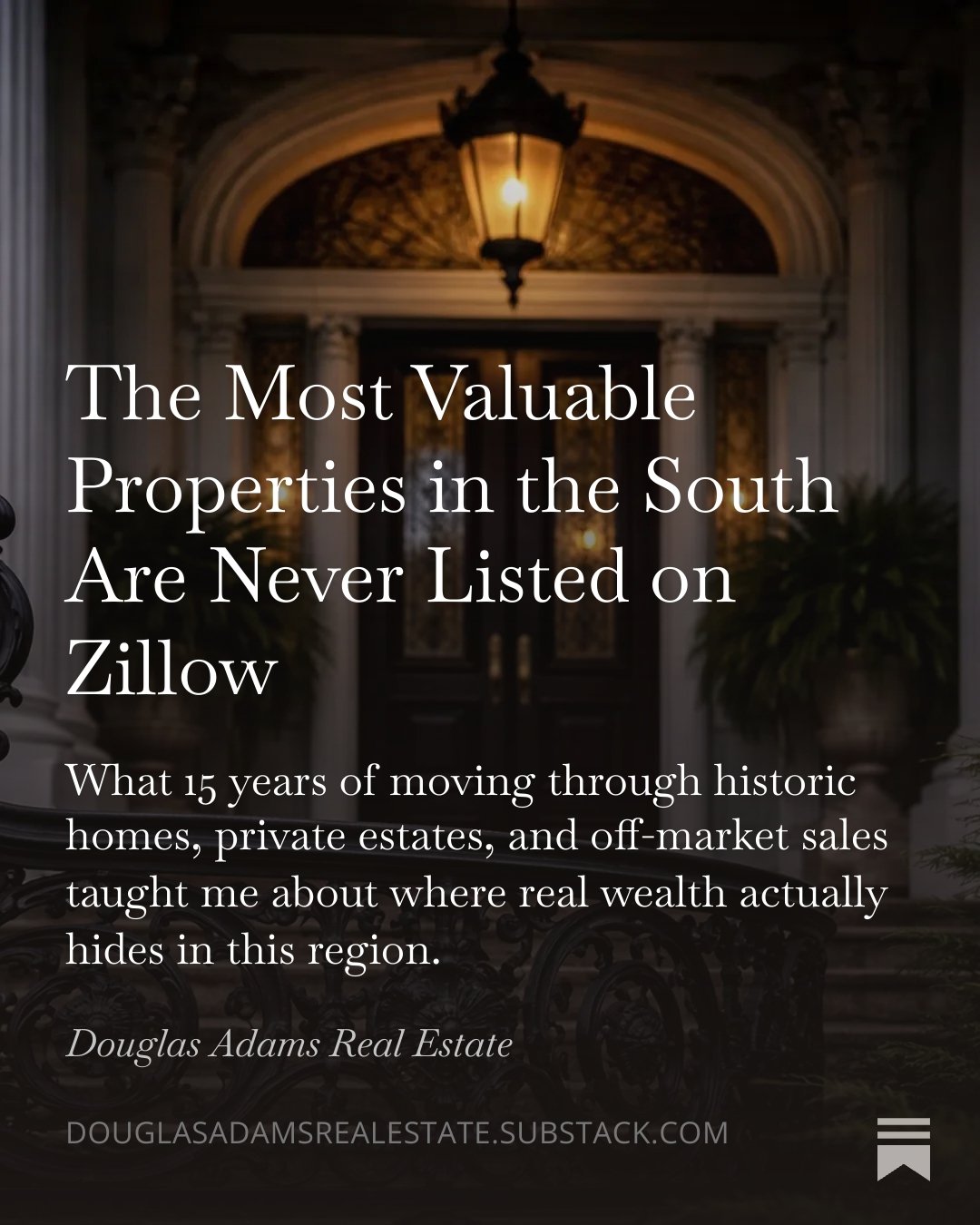
If you've been searching online for luxury real estate in the Gulf South — scrolling through Zillow, Realtor.com, or even the major brokerage portals — there's something important you need to understand: the properties that will genuinely move the needle on your life or your portfolio are almost certainly not there.
After 15 years working through historic homes, private estates, and off-market transactions across Louisiana and Mississippi, I can tell you with confidence that the most significant luxury and historic properties in this region change hands quietly. They are being discussed between attorneys. They are sitting in family trusts that haven't been formally evaluated in decades. They are Greek Revival masterpieces on the bluffs of Natchez that an owner hasn't decided to sell yet — but would, for the right conversation with the right advisor.
That gap between what is publicly listed and what is actually available — that is the market I operate in every day. And understanding it is the single most important advantage a serious buyer or seller in this region can have.
"The greatest historic properties in America's Deep South have always changed hands the same way great art does — privately, deliberately, and usually between people who already knew each other."
The Gulf South Corridor: One of America's Most Misunderstood Luxury Markets
As a luxury real estate advisor with Crescent Sotheby's International Realty, licensed in both Louisiana and Mississippi, my market corridor runs from New Orleans north through the Natchez Trace to Jackson and beyond. This stretch of the American South is one of the most architecturally and historically significant landscapes in the entire country — and one of the least understood by buyers coming from outside the region.
When buyers think Gulf South luxury real estate, they think New Orleans. And New Orleans is extraordinary — the Garden District, the French Quarter, Uptown, the Warehouse District. The architecture is world-class and the culture is unmatched. But the conversation stops there for most people, and that is exactly where the opportunity begins.
Natchez, Mississippi: The Most Undervalued Historic Property Market in America
Natchez is where the conversation gets genuinely compelling for a sophisticated buyer. Antebellum estates with documented provenance dating to the 1830s — properties with architectural pedigree, river bluff settings, and histories that predate the Civil War — trade at a fraction of what comparable historic properties command in Charleston, South Carolina or Savannah, Georgia.
The architecture is comparable. The historical significance is comparable. In many cases the provenance is superior. What is not comparable — yet — is the market awareness. Natchez remains one of the last places in America where a buyer with vision and the right advisor can acquire a genuinely significant historic property without competing against a field of thirty other bidders. That window will not stay open indefinitely.
Hattiesburg and the Pine Belt: Executive Value for the Out-of-State Buyer
Further east, the Hattiesburg market — anchored by the University of Southern Mississippi and a growing professional and medical community — offers a different but equally compelling value proposition. A 4,200-square-foot Acadian estate on rolling acreage in this corridor represents extraordinary value for an executive or equestrian buyer relocating from Houston, Atlanta, or Dallas. The lifestyle quality is exceptional. The price point relative to comparable markets is striking.
What Facilitating a Frank Lloyd Wright Transfer Taught Me About Historic Stewardship
In late 2025, I had the privilege of facilitating the transfer of Fountainhead — a Frank Lloyd Wright-designed home in Jackson, Mississippi — to the Mississippi Museum of Art as a public trust. It stands as one of the most professionally meaningful transactions of my career, and it crystallized something I had been thinking about for a long time.
Historic preservation and real estate are not separate disciplines. They are the same conversation. A property like Fountainhead is not simply an asset with a square footage and a market value. It is a cultural artifact, an architectural argument, a piece of American design history that belongs — ultimately — to a broader story than any single owner's tenure.
The buyers, sellers, and institutions who steward remarkable properties deserve advisors who understand that. Who can walk into a documented antebellum estate and speak intelligently about its structural history, its place in the architectural record, and its long-term cultural value — not just calculate a price per square foot and schedule a showing.
That is the standard I hold myself to in every client relationship and every listing I take on in this corridor.
"The Gulf South is one of the last places in America where you can still acquire a genuinely significant historic property without competing against thirty other bidders. That window won't stay open forever."
Why the Most Significant Properties in the Gulf South Never Appear Online
The off-market nature of significant Gulf South real estate is not accidental. It is structural, and it reflects how wealth and property have moved through this region for generations.
Historic families with multi-generational properties do not list on Zillow. They call advisors they trust — or advisors who were referred by someone they trust. Estate attorneys managing complex trust situations need a discreet, experienced point of contact who can move quietly and competently. High-net-worth buyers relocating from other markets — including the professional athletes I work with coming into New Orleans — require a level of discretion and market depth that public listing platforms simply cannot provide.
Access to these properties comes from relationships built over years, from a reputation for discretion and competence, and from being genuinely embedded in the communities where these homes exist. It cannot be replicated by a search algorithm.
A Background Built for This Market
My path to luxury and historic real estate advisory work was not a straight line, and I believe that is exactly what makes me effective in this niche.
I spent years as a Director of Mortgage Lending before transitioning to sales — which means I understand how a transaction is structured financially, not just aesthetically. Before that I built a career in real estate photography, which trained my eye and deepened my understanding of how a property tells its own story visually. Those two backgrounds combined create something unusual: an advisor who can walk through an architecturally significant home, understand its market position and its financing structure, and present it compellingly to the right audience.
I also work with professional athletes relocating to the New Orleans market — a client category that demands absolute discretion, deep market knowledge, and the ability to move quickly and quietly. That work has sharpened my understanding of what trust actually means in a high-stakes transaction.
What This Means If You're Buying or Selling in the Gulf South
If you are a buyer looking for a significant luxury or historic property in Louisiana or Mississippi, the most important thing you can do is stop searching portals and start a conversation. The property you are looking for may already exist — it may just not be findable the way you are currently looking.
If you are a seller — particularly a family or estate managing a historically significant property — the decision about who represents you matters enormously. The right advisor brings not just marketing capability but genuine market depth, an understanding of your property's cultural context, and the discretion to manage a complex transaction with care.
In either case, the conversation starts the same way: with someone who knows this market the way I do, who has spent 15 years building the relationships that make off-market access possible, and who approaches every property — listed or not — as something worth understanding deeply before it is positioned or pursued.
Stay Connected: The Douglas Adams Real Estate Newsletter
For ongoing market intelligence on the Gulf South luxury and historic property corridor — including off-market insights, neighborhood deep dives, and perspectives on where this market is heading — I publish a regular newsletter on Substack.
Subscribe at douglasadamsrealestate.substack.com — it is free, it goes out regularly, and it covers this market the way I would explain it to a close friend who asked the right questions.